Choosing the best Industrial Gear Motor from China is not simply a price comparison. It requires a careful review of torque, speed ratio, motor efficiency, housing strength, and application demands. A conveyor in a dusty factory needs different protection than a clean packaging machine. Small details matter.
Experienced buyers usually begin with the operating environment. They check load cycles, starting torque, ambient temperature, mounting position, noise limits, and expected service life. A reliable supplier should provide complete technical data, material information, test records, and clear warranty terms. Certifications can support confidence, but they should never replace independent verification. Ask for samples when possible. Test them under realistic conditions.
Supplier evaluation also deserves attention. Factory visits, video inspections, production photographs, and quality-control records can reveal more than attractive catalog pages. Look for documented inspections of gears, bearings, seals, winding quality, and final assembly. A responsive engineering team is valuable when dimensions change or unusual loads appear. Yet, no supplier is perfect. Delivery estimates may shift, and published efficiency figures may not match every working condition. That possibility should be discussed openly.
The best choice depends on performance, consistency, support, and total ownership cost. A slightly more expensive motor may reduce downtime and replacement expenses. Conversely, an expensive model may be unnecessary for a light-duty application. This guide compares important specifications, manufacturing practices, supplier credibility, and after-sales support. Its goal is practical judgment, not a universal answer. Look beyond the label. Evaluate the evidence.
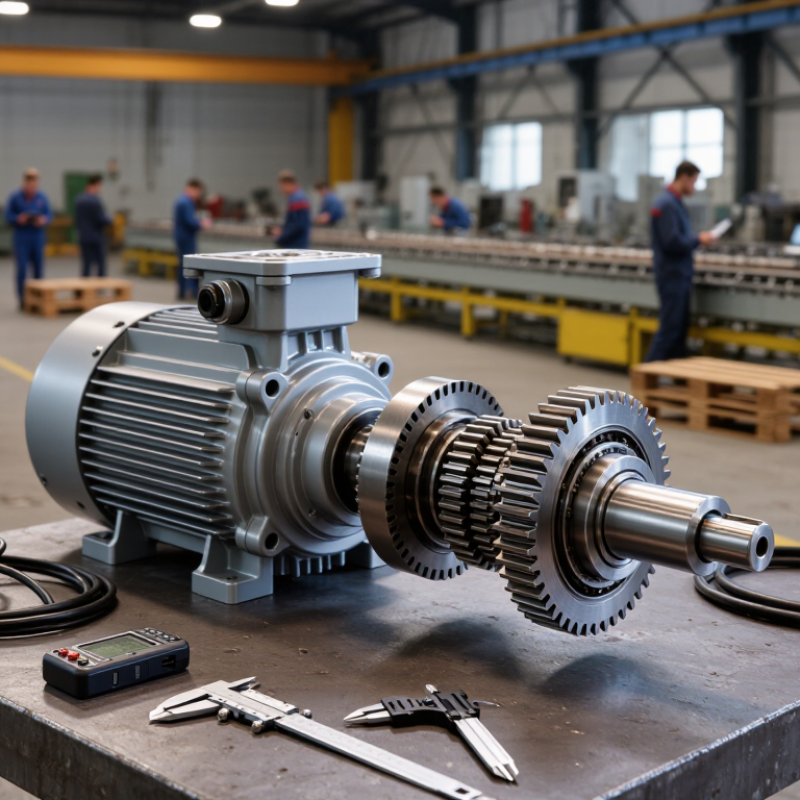
The best industrial gear motor from China is not defined by origin alone. It is defined by measured performance, stable production, and honest technical support. In a factory, I look beyond catalog torque. I check rated output, service factor, thermal behavior, and noise under continuous load. A motor that survives a dusty eight-hour shift is more valuable than one with impressive laboratory figures. Gear teeth should mesh smoothly. Shafts should show minimal play. Housing seals must resist oil and moisture. These details reveal engineering discipline.
Reliability also depends on documentation. A dependable manufacturer provides test records, dimensional drawings, lubrication guidance, and clear warranty terms. Ask for efficiency data at your actual speed and load, not only peak values. Inspect sample units before approving volume production. I have seen small alignment errors create heat, vibration, and premature bearing wear. The mistake was mine too: I trusted a specification sheet without checking the installation conditions. Good judgment includes admitting that gap. Response time matters when a line stops. Technical staff should explain failures with evidence, not vague promises.
Tips: Match the gearbox ratio to the machine cycle. Confirm mounting dimensions. Test temperature after several hours. Keep spare seals and bearings available. Do not choose the lowest quote automatically. It may become the costliest decision.
Choosing the best industrial gear motor from China starts with the application, not the catalog. Helical gear motors suit conveyors, mixers, and packaging lines because they deliver efficient, steady torque. Bevel-helical units handle right-angle drives where floor space is limited. Worm gear motors remain compact and affordable for gates, feeders, and light-duty lifting, but their sliding contact creates more heat and lower efficiency. Planetary gear motors provide high torque in a small housing, making them useful for robotics, machine tools, and heavy indexing equipment.
The International Energy Agency has estimated that electric motor systems consume about 53% of global electricity and nearly 70% of industrial electricity. Small efficiency gains matter. A motor running continuously beside a dusty conveyor can waste more energy than expected. The U.S. Department of Energy also identifies motor-driven equipment as a major share of industrial electricity use. Therefore, buyers should verify rated efficiency, service factor, duty cycle, insulation class, and ingress protection. Torque at startup matters more than attractive nameplate power.
Practical testing is essential. Ask for load-test records, noise measurements, thermal-rise data, and dimensional drawings. Confirm whether the gearbox survives frequent reversing and shock loads. ISO 9001 certification supports process consistency, but it does not guarantee perfect field performance. That distinction is easy to miss. I would also inspect lubricant selection and shaft sealing before approval. A cheaper worm unit may be correct for intermittent operation, yet costly for continuous production. The best choice is the motor that matches real load, speed, environment, and maintenance capability—not merely the lowest quotation.
Choosing the best industrial gear motor from China begins with evaluating the manufacturer, not the catalog.
A polished website proves little. Ask for factory photographs, production capacity, inspection records, and recent export experience. Reliable suppliers explain gear geometry, housing materials, lubrication, and thermal limits in practical language. Vague answers deserve caution. Request drawings, load calculations, and a sample test report before discussing large quantities. Confirm whether ratings cover continuous duty, starting torque, ambient temperature, and mounting position. These details often expose unrealistic performance claims.
During a previous sourcing project, I compared two factories with similar prices. One supplied a clean test sheet but could not show calibration dates. The other opened its assembly area and demonstrated backlash measurement. I preferred the second option, although its documentation needed improvement. That decision was not perfect. Ask how incoming components are checked. Inspectors should record bearing clearance, gear noise, shaft runout, insulation resistance, and final torque. A credible manufacturer can trace each motor to a batch number. It should also explain corrective action after failures.
Evaluate engineering support after delivery. Can technicians review your duty cycle and recommend a service factor? Will they provide replacement seals, wiring diagrams, and maintenance guidance? Response speed matters when a conveyor stops at midnight. Request a pilot order and test motors under your actual load. Measure temperature, vibration, noise, and current draw for several operating cycles. Do not rely only on laboratory data. A factory may pass a short test and still miss long-term heat problems. Check packaging, moisture protection, spare-part availability, and warranty terms in writing.
Choosing the best industrial gear motor from China starts with measurable performance, not attractive catalog claims. The IEA’s Energy Efficiency 2023 analysis estimates that electric motor systems consume about 53% of global electricity. Small efficiency losses can therefore become major operating costs. Request rated torque, output speed, service factor, duty cycle, and efficiency at actual load. A motor rated for continuous S1 duty should survive your production schedule, not just a short laboratory test. Check thermal class, insulation resistance, noise, vibration, and gearbox backlash.
Certification must match the destination market. IEC 60034-30-1 defines motor efficiency classes, including IE3 and IE4. However, an IE rating does not automatically prove complete gear-motor efficiency. Ask for test conditions, measured curves, and traceable laboratory records. IEC 60529 IP ratings also matter. An IP65 enclosure resists dust and water jets, but it does not guarantee chemical resistance or safe operation in every environment. The details matter.
Quality evidence should include ISO 9001-based process control, batch traceability, incoming-material inspection, and documented load testing. Request serial-number records and a sample inspection before shipment. I have found that oil leakage, loose bearings, and incorrect voltage often appear during integration, not factory demonstrations. That is uncomfortable, but realistic. A supplier’s certificate is only a starting point. Compare warranty terms, spare-part availability, response time, and acceptance criteria in writing. Independent verification may cost more initially, yet it can expose optimistic torque claims before installation.
What Is the Best Industrial Gear Motor from China?
Selecting the right gear motor starts with the machinery, not the catalog. Measure required torque, output speed, starting load, duty cycle, and mounting space. A conveyor carrying 800 kilograms needs different protection from a packaging line running short, frequent cycles. Calculate the service factor carefully. My field experience suggests that undersized units fail quietly at first, then overheat during peak production.
The U.S. Department of Energy reports that motor-driven systems can consume more than 70% of electricity in manufacturing. Efficiency therefore affects operating cost, not only purchase price. Check rated efficiency, gearbox losses, thermal capacity, and actual load conditions. IEC 60034 data can support motor comparisons, while ISO 6336 calculations help evaluate gear strength. Ask the Chinese manufacturer for load-test records, noise measurements, insulation class, IP rating, and traceable component information. Certification alone is not enough.
For dusty workshops, sealed housings and suitable IP protection matter. For washdown areas, corrosion-resistant materials may justify a higher cost. Helical gearboxes usually offer efficient, quiet operation; worm gears can provide compact ratios, but often lose more energy. Confirm backlash and shaft alignment before ordering. I once treated a nominal torque value as continuous torque. That was a poor assumption. Request drawings, tolerance ranges, spare-part availability, and a sample test under your real load. A slightly slower motor may outperform a faster unit when heat, maintenance, and energy use are measured over several years.
| Gear Motor Type | Typical Output Torque | Typical Gear Ratio | Typical Efficiency | Best-Suited Machinery | Main Advantages | Key Selection Considerations |
|---|---|---|---|---|---|---|
| Helical Gear Motor | Approximately 50–18,000 N·m | Approximately 3:1–280:1 | Typically 90–97% | Conveyors, packaging lines, mixers, material-handling systems | High efficiency, quiet operation, compact inline design | Check continuous torque, service factor, mounting position, and thermal capacity |
| Worm Gear Motor | Approximately 10–4,000 N·m | Approximately 5:1–100:1 | Typically 50–90% | Gates, lifts, small conveyors, indexing equipment, positioning mechanisms | Simple construction, high reduction ratios, low cost, compact right-angle layout | Confirm allowable duty cycle, heat dissipation, back-driving requirements, and lubrication |
| Bevel Helical Gear Motor | Approximately 200–50,000 N·m | Approximately 3:1–200:1 | Typically 92–98% | Heavy conveyors, palletizers, processing machinery, industrial transport systems | High torque density, efficient right-angle transmission, robust construction | Evaluate shock loads, radial and axial shaft loads, braking requirements, and installation space |
| Planetary Gear Motor | Approximately 100–100,000 N·m | Approximately 3:1–1,000:1 | Typically 94–98% | Robotics, extruders, hoists, high-load automation, precision drive systems | Very high torque density, low backlash options, excellent load distribution | Verify peak torque, torsional stiffness, backlash, bearing capacity, and maintenance access |
| Cycloidal Gear Motor | Approximately 500–60,000 N·m | Approximately 6:1–119:1 per stage | Typically 80–93% | Heavy-duty conveyors, agitators, cranes, wastewater equipment | High shock-load resistance, compact size, long service life under demanding loads | Check vibration, allowable overhung load, oil grade, duty cycle, and replacement-part availability |
| Selection Parameter | What to Calculate or Confirm | Practical Guidance |
|---|---|---|
| Required Output Torque | Load torque, acceleration torque, and peak torque | Select a unit with sufficient continuous and peak torque capacity, including the appropriate service factor. |
| Output Speed | Required revolutions per minute at the driven shaft | Choose the ratio and motor speed that provide the required operating speed without excessive heat or slip. |
| Operating Duty | Operating hours, starts per hour, load profile, and reversing frequency | Continuous, intermittent, reversing, and shock-load applications require different service-factor calculations. |
| Motor Electrical Data | Rated voltage, frequency, phase, power, current, and starting method | Match the motor to the available power supply and verify compatibility with a variable-frequency drive when required. |
| Environment | Ambient temperature, dust, moisture, chemicals, washdown, and altitude | Specify the required enclosure protection, corrosion resistance, seals, paint system, and thermal derating. |
| Mechanical Installation | Mounting position, shaft orientation, flange or foot mounting, and available space | Confirm dimensions, shaft tolerances, coupling type, lubrication position, and access for maintenance. |
| Compliance and Documentation | Required safety, efficiency, test, and material documentation | Request dimensional drawings, wiring diagrams, test reports, efficiency data, manuals, and traceable quality records. |
| Lifecycle Cost | Purchase price, energy use, lubrication, downtime, and spare parts | Compare total cost of ownership rather than selecting solely on initial purchase price. |
Note: The performance ranges above are typical engineering reference values. Actual ratings depend on the specific gear geometry, motor size, lubrication, duty cycle, ambient conditions, and manufacturer test method.
Evaluate the factory, not only its catalog or website. Ask for production photos, capacity details, inspection records, and recent export experience. Vague answers deserve caution. Request drawings, load calculations, and a sample test report before ordering.
Request rated torque, output speed, service factor, duty cycle, and efficiency at your actual load. Confirm continuous S1 duty capability for your production schedule. Check starting torque, ambient temperature, mounting position, thermal class, and insulation resistance. Short tests can hide long-term heat problems.
Inspectors should record bearing clearance, gear noise, shaft runout, and final torque. They should also check insulation resistance and gearbox backlash. Incoming components need documented inspection. Small details matter.
Ask for calibration dates, traceable laboratory records, and batch-number tracking. A clean test sheet proves little without verification details. Request serial-number records and a sample inspection before shipment. I once preferred better factory access over better paperwork. That choice was not perfect.
No. An efficiency rating applies to defined motor conditions. It does not automatically prove complete gear-motor efficiency. Request measured curves and test conditions. An IP65 enclosure resists dust and water jets. It does not guarantee chemical resistance or universal safety.
Ask whether production follows ISO 9001-based process controls. Check applicable motor efficiency classes, such as IE3 or IE4. Request batch traceability, load-testing records, and corrective-action reports. Certificates are only a starting point.
Laboratory data may not match your conveyor, mixer, or production line. Run pilot motors through several operating cycles. Measure temperature, vibration, noise, and current draw. Watch for oil leakage, loose bearings, and incorrect voltage. Integration can reveal uncomfortable problems.
Technicians should review your duty cycle and recommend a suitable service factor. Request wiring diagrams, replacement seals, maintenance guidance, and spare-part details. Written warranty terms and acceptance criteria reduce confusion. Response speed matters when equipment stops at midnight.
Choosing the best Industrial Gear Motor from China requires more than comparing prices. The ideal motor should combine efficient power transmission, reliable construction, stable operation, and suitability for the intended working environment. Different gear motor types, including helical, worm, planetary, and bevel designs, serve different industrial needs such as conveyors, mixers, lifting equipment, packaging systems, and automated machinery. Understanding the required torque, speed, load pattern, installation position, and duty cycle is essential before making a decision.
A dependable manufacturer should demonstrate consistent production processes, strict quality control, technical expertise, and clear communication. Buyers should also review performance data, material quality, thermal management, noise levels, service life, and relevant certifications. Selecting the right Industrial Gear Motor ultimately involves matching its specifications with the machinery’s operating demands while considering maintenance, energy efficiency, customization, delivery reliability, and long-term support. A careful evaluation helps ensure safe, stable, and cost-effective performance across demanding industrial applications.

Syncdrive Motor